A strong title tag is not a slogan. It is a compact label for a specific URL. The best titles help search systems understand the page and help humans decide whether the click is worth their time.
Most weak title tags fail because they are written before the page has a job. The writer starts with a keyword, adds a brand, and hopes the phrase feels official. Better titles start with the page purpose: what is this URL uniquely responsible for, who should choose it, and what detail separates it from nearby pages on the same site.
Reproducible review note
How we checked this guide
- Evidence type
- Production site audit · September 4, 2026
- Scope
- All 23 canonical URLs in the ToolHub Metadata sitemap, supplemented by the four fictional worked examples.
- Method
- We fetched every sitemap URL, compared the supplied title with the canonical URL and visible page purpose, and then applied the four-part title model to the SaaS, local-service, article, and product teaching scenarios.
- What the check showed
- All 23 audited production URLs returned a distinct title and self-referencing canonical. The teaching comparison showed that page topic and one supportable qualifier were more useful than a fixed character target.
- Boundary
- Search engines can rewrite title links. The worksheet helps editors improve the supplied title; it cannot guarantee the exact wording shown in results.
Reviewed by ToolHub Metadata Editorial. The review date records a substantive content or verification change.
Key takeaways
- Lead with the topic users are actually searching for, then add a useful qualifier.
- Use the brand as a trust anchor, not as filler that pushes the main topic out of view.
- Give every indexable URL a title that could not be copied onto another page without becoming inaccurate.
- Review titles beside the visible H1 and page intro so the snippet does not overpromise.
Start with the page job
Before writing the tag, write a plain sentence that explains the page job. A service page might need to win a local lead. A product page might need to filter buyers by size, material, or compatibility. A guide might need to promise a method, not a vague topic.
When the job is clear, the title becomes easier. You are no longer trying to include every keyword variation. You are choosing the phrase that best labels the page and the one qualifier that helps the right user pick it.
- Service page job: prove this service is available in this place for this type of need.
- Product page job: identify the product and the deciding attribute.
- Guide page job: show the skill or decision the reader will finish with.
- Comparison page job: make the compared options and evaluation angle obvious.
Use a four-part title model
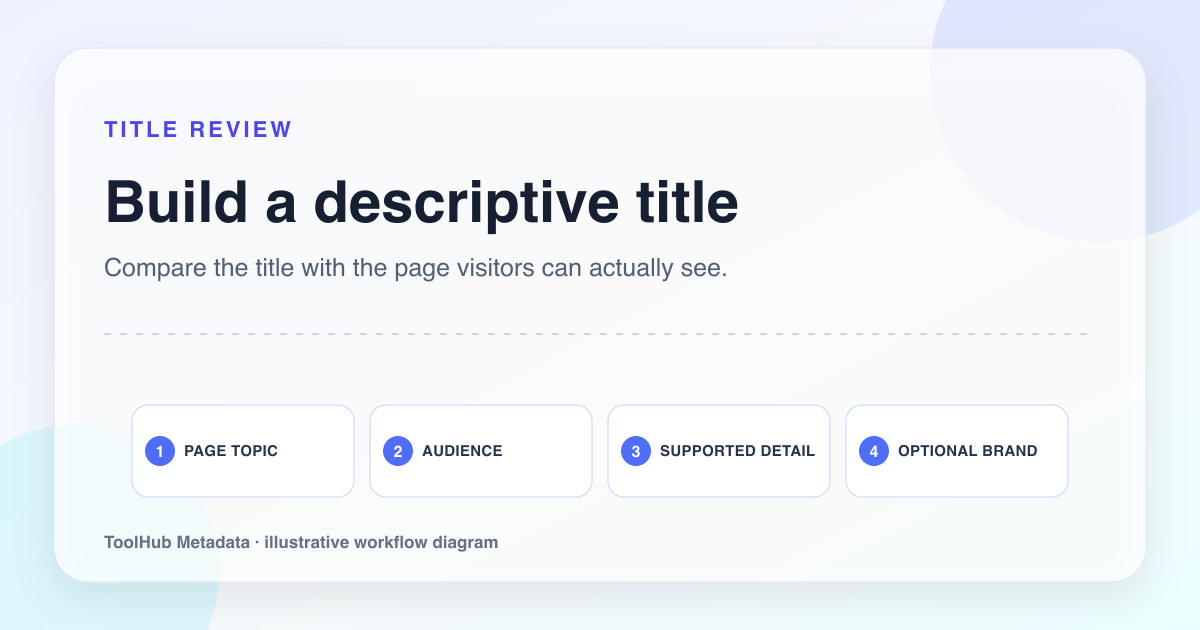
The most reliable structure is topic, qualifier, proof or outcome, and brand. You do not need all four parts every time, but thinking through them prevents thin titles. The topic names the page. The qualifier narrows the audience or use case. The proof or outcome explains why the page deserves the click. The brand closes the loop when it adds trust.
This model also makes duplicate titles easier to catch. If two pages have the same topic and qualifier, they may be competing for the same intent. Merge them, differentiate them, or make one non-indexable before adding another near-duplicate URL to the site.
Local service page
Plumbing Services | Hart Plumbing
Emergency Plumber in Austin, TX | 24/7 Leak Repair | Hart Plumbing
Avoid title inflation
Title inflation happens when every page tries to be the most complete, best, affordable, trusted, and ultimate result. The tag becomes long, repetitive, and hard to trust. Search systems may rewrite it, but the larger issue is editorial discipline: a title that sounds inflated usually points to a page that has not chosen a clear angle.
Keep the title close to the content. If the title says complete guide, the page should actually contain a complete method. If the title mentions pricing, the page should expose pricing or explain why pricing varies. If the title says for beginners, the opening should not assume expert context.
- Remove adjectives that do not change the decision.
- Do not stack synonyms such as best, top, leading, trusted, and professional.
- Do not add a city, year, or audience unless the visible page supports it.
- Prefer one strong qualifier over three weak ones.
Review titles as a set
A title audit is more useful than editing one tag at a time. Export the indexable URLs, titles, H1s, and canonical targets. Sort the list by title. Repetition becomes visible quickly: home page wording copied to category pages, location pages with only the city swapped, or articles that use the same generic pattern.
For a small site, this review can be done manually in a spreadsheet. For a growing site, make it part of the publishing checklist. Every title should have a reason to exist, and every title should point to a page that fulfills the promise.
Pre-publish checklist
- The title names the page topic in the first half.
- The main qualifier is visible on the page, not only in metadata.
- The title is unique across indexable URLs.
- The brand is included only when it adds clarity or trust.
- The tag still reads naturally when shown without the meta description.