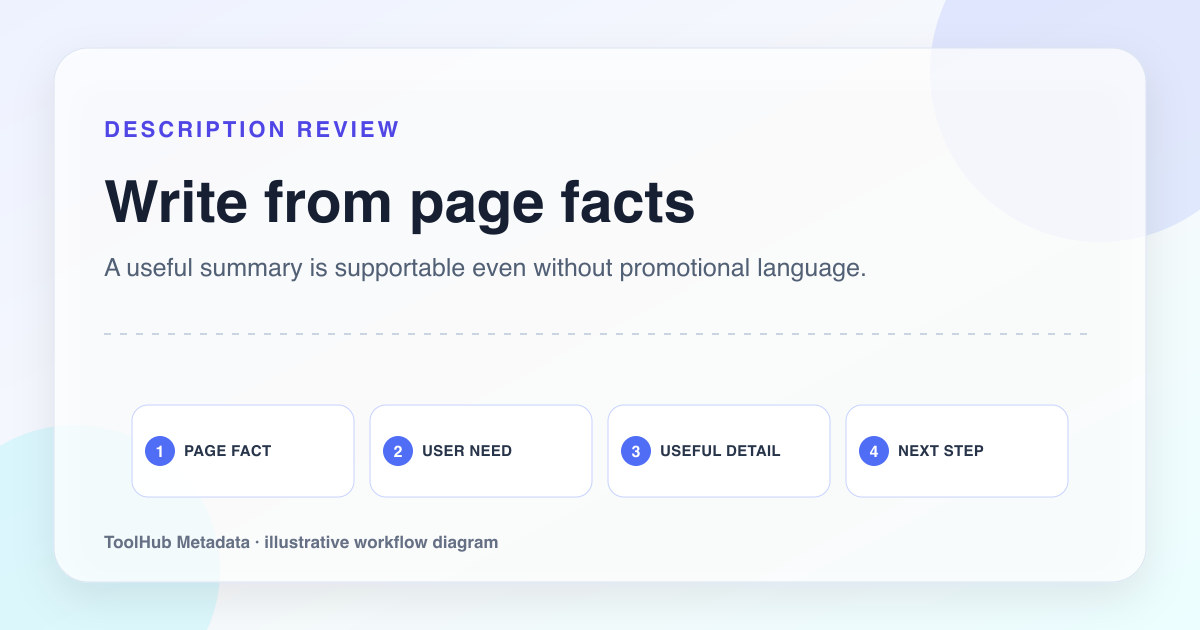
A meta description is not a ranking lever in the simple way many people want it to be. Its job is packaging. It gives the searcher a preview of what they will get after the click, and it should help the right visitor choose the page while discouraging poor-fit clicks.
The most common mistake is writing a description as a small promotional pitch. The copy says the company is trusted, reliable, innovative, or passionate, but it does not explain what the page contains. Useful descriptions are specific. They mention the task, the audience, the decision, and the next step.
Reproducible review note
How we checked this guide
- Evidence type
- Controlled teaching model · September 4, 2026
- Scope
- Four explicitly fictional page types in the worked-examples library; no search-performance claim is made.
- Method
- We rewrote the descriptions in four worked page types using a page fact, audience need, differentiator, and next step, then checked that every phrase could be supported by the visible example page.
- What the check showed
- The fact-first drafts removed vague claims such as “best” and “leading” and made the snippet useful even when the call to action was removed.
- Boundary
- A supplied description may be replaced by a search engine with text from the page. Treat it as a concise candidate, not a controlled advertisement.
Reviewed by ToolHub Metadata Editorial. The review date records a substantive content or verification change.
Key takeaways
- Write descriptions after the page is drafted, not before.
- Use the first sentence to confirm the exact page topic.
- Use the second sentence to preview the evidence, process, product detail, or decision support.
- Do not promise rankings, results, savings, or outcomes the page cannot prove.
Use the intent plus proof formula
A practical description has two jobs: match the search intent and preview the proof. The formula is simple: describe the user task, then name the support the page provides. That support might be examples, pricing ranges, repair coverage, product dimensions, compatibility notes, screenshots, or a step-by-step method.
This matters because many descriptions sound polished but empty. They use the right keyword but give no reason to believe the page will answer the question. The proof phrase is what makes the snippet feel grounded.
Guide page description
Learn helpful tips and best practices for meta descriptions so your website can get better results online.
Use a repeatable rewrite system for meta descriptions, with weak and stronger examples, review checks, and page-type patterns for service, product, and guide pages.
Match the description to the page type
Different pages need different description logic. A local service page should set expectations about location, availability, and service scope. A product page should mention the differentiating attribute a buyer can verify. A guide should state what the reader will be able to do. A comparison page should explain the criteria used, not only list names.
When descriptions are copied across page types, they lose usefulness. A product description that reads like a blog intro feels vague. A guide description that reads like a sales pitch feels untrustworthy. Write the snippet in the language of the page job.
- Local page: service, area, urgency or appointment model, and proof.
- Product page: product identity, size or compatibility, benefit, and buying context.
- Guide page: task, method, examples, and final outcome.
- Comparison page: options compared, criteria, and who the comparison helps.
Keep it honest when Google rewrites it
Google may generate a different snippet from visible page text when that better matches the query. That is not a failure by itself. The practical response is to make the visible introduction and section openings as clear as the meta description. If the page has one clear message, both the supplied description and rewritten snippets are more likely to stay useful.
Avoid hiding the real answer deep in the page. A description that promises direct help but opens with a long brand story creates a mismatch. Put the answer, scope, or method in the first screen and let the description reflect that same structure.
Run a duplicate description audit
Duplicate descriptions are not always a policy problem, but they are often a quality signal problem. They suggest a site is using a template without enough page-level judgment. For a small public tool site, that matters because visitors and crawlers are evaluating whether the site offers real usefulness, not only generated page wrappers.
Build a simple sheet with URL, title, H1, description, and page purpose. Sort by description. Any repeated description should be justified by a canonical relationship or rewritten so it reflects the actual URL.
Pre-publish checklist
- The description says what the page contains, not only what the brand wants.
- The copy includes one concrete detail a visitor can verify after the click.
- The description is unique for every indexable URL.
- The visible introduction supports the same promise.
- Claims about outcomes, rankings, savings, or speed are either removed or supported on the page.