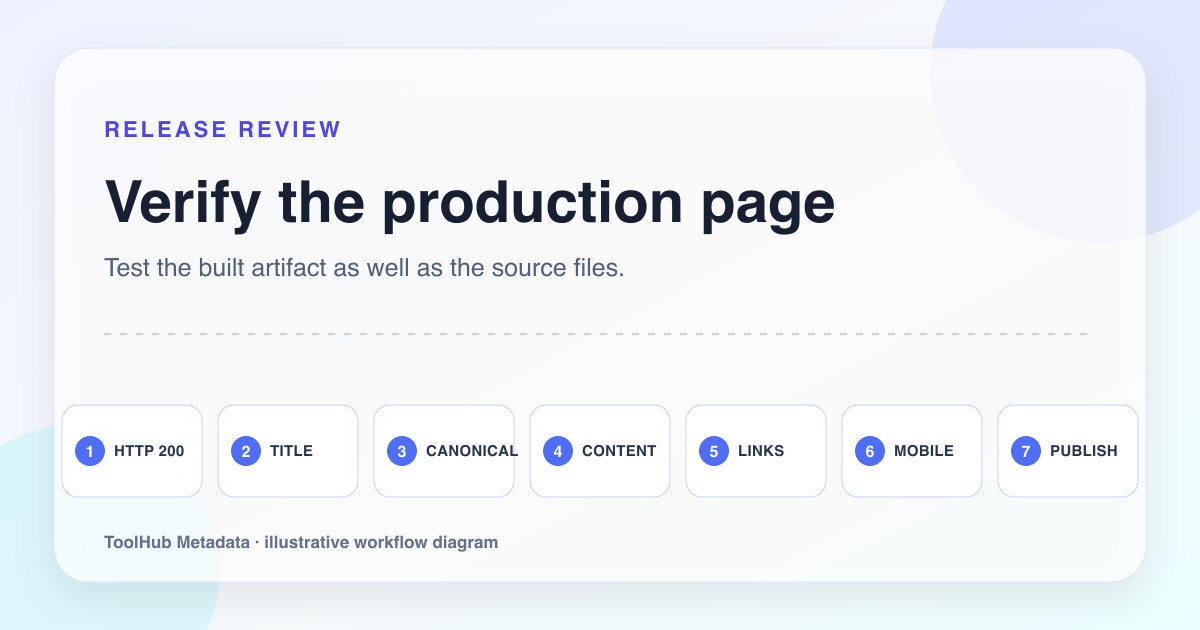
Publishing quality is not one decision. It is a series of small checks that prevent avoidable mistakes. A page can have excellent writing and still look low quality if the title is duplicated, the canonical points to the wrong URL, the image hotlinks another domain, or the sitemap date is stale.
A checklist is especially useful for small teams because it turns quality into a repeatable habit. You do not need a large editorial department to maintain a good site. You need clear standards, a review path, and the discipline to stop weak pages before they go public.
Reproducible review note
How we checked this guide
- Evidence type
- Production site audit · September 4, 2026
- Scope
- An isolated Nuxt production artifact, 13 representative HTML routes, redirects, noindex headers, public assets, and ad-script exclusions.
- Method
- We ran the checklist against the production build: status codes, titles, descriptions, canonical links, robots directives, structured data, navigation, mobile layout, and isolated deployment files.
- What the check showed
- The build check catches missing production assets and route failures that source-only review misses, while the worksheet keeps page-level editorial checks visible.
- Boundary
- A local build cannot prove DNS, indexing, consent behavior by region, or third-party availability. Those require checks on the deployed domain.
Reviewed by ToolHub Metadata Editorial. The review date records a substantive content or verification change.
Key takeaways
- Review content, metadata, technical signals, and policy alignment together.
- Use local or controlled assets for page images and previews.
- Confirm the deployed HTML, not only the framework source.
- Record the last reviewed date so maintenance is visible.
Content checks
The page should have a clear audience, a clear job, and visible original value. Original value can be a worked example, a process, a comparison, a checklist, a template, or an explanation grounded in real page-building decisions. Avoid publishing pages that simply restate common definitions.
The introduction should tell readers what they will get. The headings should form a useful outline. The conclusion or checklist should help the reader act without needing to reread the entire page.
- One primary page job.
- Specific examples or evidence close to important claims.
- No placeholder sections or generic filler.
- Clear next step through internal links.
Metadata checks
Every public page needs a unique title and description. The title should label the page accurately. The description should preview the page value. Open Graph and Twitter tags should use local images and page-specific copy. The canonical should match the final clean URL.
Metadata should be reviewed beside the page content. If the metadata promises something the content does not deliver, change the page or the metadata before publishing.
Metadata review question
Does the title include the keyword?
Would this title and description still be accurate if shown without any other context?
Technical checks
Open the deployed page and inspect the final HTML. Confirm status 200, canonical URL, robots directive, language attribute, title, description, structured data, image URLs, and internal links. For JavaScript apps, make sure the core content appears in server-rendered HTML when possible.
Check mobile layout and accessibility basics. Headings should follow a reasonable order. Images should have alt text. Links should be descriptive. Forms should have labels. These details help users and signal that the page was built with care.
Maintenance checks
Publishing is not the end. Add a reviewed date, update the sitemap lastmod, and keep a note of what changed. If the article depends on platform behavior, set a review reminder. If the page references scripts or policies, update policy pages when implementation changes.
This maintenance record is useful during major launches because it turns vague hope into evidence. You know what was improved, when it was deployed, and how it was verified.
Pre-publish checklist
- The page has one clear user job and enough original value.
- Title, description, canonical, OG, and Twitter fields are unique and accurate.
- Images are local or controlled assets with alt text.
- Final deployed HTML contains the core content and correct head tags.
- Sitemap, internal links, and reviewed date are updated.