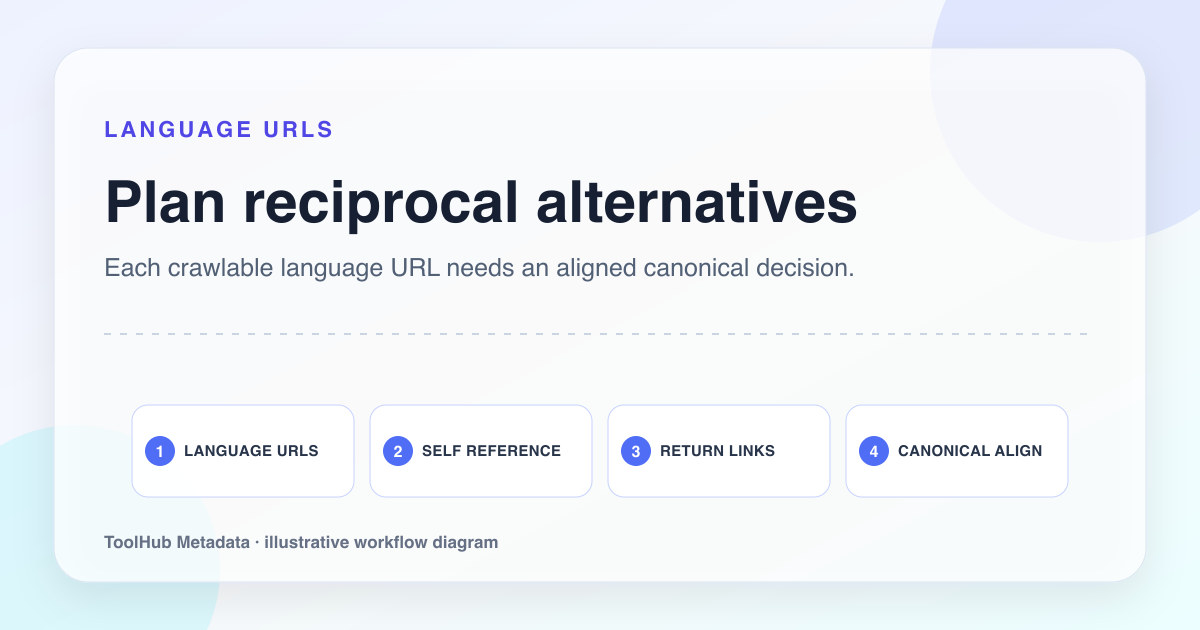
Hreflang is not a translation badge. It is a system for telling search engines which alternate URLs serve the same or equivalent content for different languages or regions. Used well, it reduces wrong-country results. Used poorly, it creates a confusing web of broken references.
Small sites should implement hreflang only when the content and operations support it. A translated headline with the same English body is not enough. Currency, examples, shipping, legal language, support paths, and screenshots may also need localization.
Reproducible review note
How we checked this guide
- Evidence type
- Controlled teaching model · September 4, 2026
- Scope
- A four-row teaching matrix for reciprocal language URLs; ToolHub Metadata does not publish localized page variants.
- Method
- We modeled a small English/Spanish page set and checked reciprocal links, self-references, canonical alignment, locale codes, and an optional x-default destination.
- What the check showed
- A simple URL matrix caught missing return links before markup was generated and made it obvious when a translated page did not have a true counterpart.
- Boundary
- This workflow assumes separate crawlable URLs. Locale detection, regional content strategy, and large sitemap implementations require additional planning.
Reviewed by ToolHub Metadata Editorial. The review date records a substantive content or verification change.
Key takeaways
- Use hreflang when you have real alternate URLs for equivalent content.
- Every alternate should reference the full set of alternates, including itself.
- Use language-only codes when regional targeting is not necessary.
- Do not create thin localized pages just to appear international.
Decide whether localization is real
Before adding tags, review the page itself. Does the localized version help a user in that language or region? Does it translate the important content? Does it adapt examples, units, pricing, support, and legal details where needed? If not, hreflang may be premature.
Thin localization can look like weak duplication. It creates more URLs without enough unique usefulness. A small site is usually better with fewer strong pages than many shallow language variants.
- Language-only version: useful when the language changes but region does not matter.
- Region version: useful when pricing, shipping, legal, or terminology differs by country.
- x-default: useful for a global selector or fallback page.
- No hreflang: appropriate when there are no equivalent alternate pages.
Build a reciprocal map
Hreflang works as a set. If the English page references the French page, the French page should reference the English page and itself. Missing return tags are one of the most common implementation errors. Build the map in a table before writing code.
The table should include canonical URL, language-region code, title, publish status, and last verification date. This prevents stale alternate links when pages move or launches happen at different times.
Two-language set
English page links to French, but French page does not link back.
English and French pages each list en, fr, and x-default alternates with final canonical URLs.
Keep canonical and hreflang aligned
Each language version should normally canonicalize to itself, not to the English master page. If all localized pages canonicalize to one language, they are telling search systems not to treat the alternates as independent results. That contradicts hreflang.
The canonical says which URL represents this page. Hreflang says which equivalent URLs exist for other audiences. They should cooperate, not fight.
Test the rendered HTML
Frameworks often generate head tags dynamically. Test the deployed HTML for each locale, not only the source code. Confirm every alternate URL returns 200, has the correct canonical, and includes reciprocal hreflang references.
If a language version is not ready, keep it out of the hreflang set. A broken alternate is worse than no alternate because it creates crawler work and user confusion.
For small teams, the most reliable habit is to keep the hreflang map next to the publishing checklist. When a translated page is edited, moved, or removed, the map should be updated in the same change. That prevents old alternates from surviving simply because nobody remembered they were generated in the page head.
Pre-publish checklist
- Every hreflang URL is a real equivalent page, not a placeholder.
- Every page in the set references every other page and itself.
- Canonical tags are self-referencing for localized pages.
- Language and region codes are valid and intentional.
- The deployed HTML and sitemap agree after publishing.