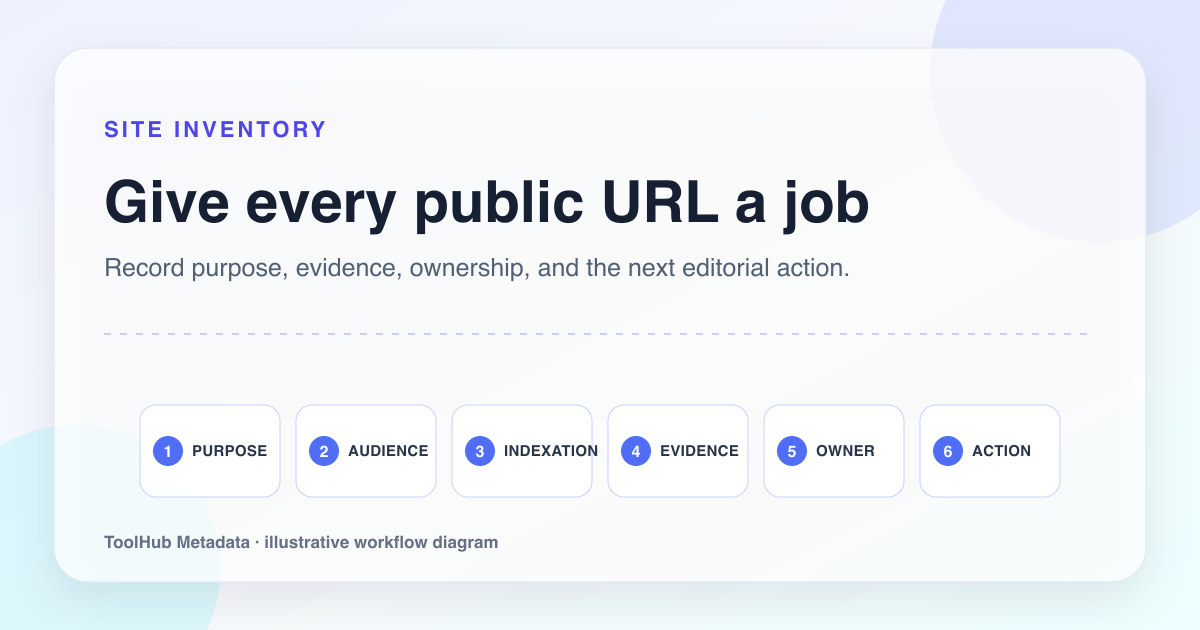
A small tool site can look thin when its pages are not clearly connected. The generator may be useful, the examples may be useful, and the support pages may be honest, but a visitor still needs to understand why each public URL exists. A content inventory turns that judgment into a concrete map.
The inventory is not about word count alone. A short tool page can be valuable if it solves a real task. A long article can still be weak if it is generic, copied, or unsupported. The goal is to document what each URL helps a visitor do, what evidence or examples it contributes, and when it was last checked.
Reproducible review note
How we checked this guide
- Evidence type
- Production site audit · September 4, 2026
- Scope
- All 23 indexable ToolHub Metadata URLs and the site-wide route roles recorded in the downloadable evidence file.
- Method
- We assigned each public site URL a page job, audience, indexation decision, canonical target, evidence type, owner, review date, and next action using the downloadable inventory.
- What the check showed
- The inventory distinguishes a useful tool, an explanatory guide, a worked example, and an operational policy page without pretending that every URL needs the same length or purpose.
- Boundary
- An inventory reveals gaps and duplication; it does not prove search demand or content quality by itself. Pages still need direct editorial review.
Reviewed by ToolHub Metadata Editorial. The review date records a substantive content or verification change.
Key takeaways
- List every public indexable URL before a major launch or content refresh.
- Classify each page by purpose, originality, maintenance status, and user value.
- Remove or improve weak pages before they become part of the public site map.
- Make policy pages truthful to the actual scripts and third-party services loaded.
Build the inventory table
Start with a simple table: URL, page type, primary audience, page job, original value, media or examples, last reviewed date, canonical URL, index status, and internal links. Fill it out manually for a small site. The act of writing the page job often reveals weak pages quickly.
If a page job sounds like "rank for keyword" or "hold a placement", rewrite it. A real page job describes the user benefit: generate metadata, compare examples, learn a publishing workflow, understand privacy behavior, or contact support.
- Page job: what the visitor can accomplish.
- Original value: examples, screenshots, templates, workflows, or editorial judgment.
- Maintenance status: current, needs update, merge candidate, or remove.
- Review evidence: last checked date and what changed.
Score originality honestly
Originality is not only whether the sentences are unique. It is whether the page gives something a reader could not get from many interchangeable summaries. That might be a local example, a decision table, a tool output, a before-and-after rewrite, a screenshot, a checklist, or a clear point of view.
Thin content often fails because it exists around a template rather than around user value. The inventory should make that distinction obvious. If a page would not be worth visiting without promotion, improve it before it stays in navigation.
Original value field
SEO guide with common tips.
Step-by-step metadata audit workflow, examples for four page types, rendered tool output, and a pre-publish checklist.
Check trust and transparency
Review the About, Contact, Privacy, Cookie, Terms, and Editorial Policy pages together. They should describe the site accurately. If analytics, fonts, advertising, or measurement scripts load, the policy pages should say exactly where. Do not claim that ad-related scripts are excluded from tool pages unless that boundary is technically enforced and tested.
Trust pages do not need legal drama. They need consistency. A small inconsistency can make the site look assembled from templates rather than operated with care.
Publish only after the public site is stable
After changes, deploy, clear cache, confirm final HTML, check the sitemap, and request indexing for the most important pages. Do not announce a major content rebuild while cached pages still show the old site. Give crawlers and visitors a stable version to evaluate.
Keep a launch note for yourself: date deployed, cache cleared, pages added, policy changes, sitemap lastmod, and verification commands. This makes future maintenance less emotional and more operational.
Pre-publish checklist
- Every sitemap URL has a documented page job.
- Content pages include original examples, workflows, or decision support.
- Weak pages are improved, merged, noindexed, or removed from the sitemap.
- Policy pages match actual tracking, advertising, and data behavior.
- Deployment and cache state are verified before the site is promoted again.